
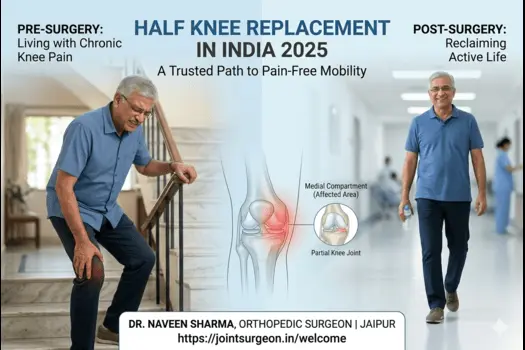
Half Knee Replacement in India: Cost, Benefits, and Recovery
This article helps patients understand knee pain, surgery selection, recovery planning, and when it is time to seek a detailed orthopedic opinion. This article helps patients understand knee pain, surgery selection, recovery planning, and when it is time to seek a detailed orthopedic opinion.Half Knee Replacement in India: Cost, Benefits, and Recovery
If you've been searching for half knee replacement - you're not alone. According to Google Trends India, searches for this term have exploded by +200% over the past year, making it the fastest-rising orthopedic query in the country. Patients across India - from Jaipur and Delhi to Hyderabad and Mumbai - are asking a critical question: Do I really need to replace my entire knee?
The answer, for many, is no. Half knee replacement - clinically known as Partial Knee Replacement (PKR) or Unicompartmental Knee Arthroplasty (UKA) - is a smarter, less invasive surgical option that replaces only the damaged portion of your knee while preserving everything healthy. This guide explains everything you need to know: what it is, who qualifies, costs in India, and how it compares to total knee replacement.
Quick Facts
- A landmark Indian study found nearly 50% of knee arthritis patients may be better suited for partial rather than total knee replacement
- Cost in India: 1,50,000 - 2,80,000 (significantly less than total knee replacement)
- Recovery time: 3-6 weeks (vs. 2-3 months for total knee replacement)
- Success rate in India: 86-89% with over 10-year implant survivorship
- Walking possible: Within 24 hours of surgery
What Is Half Knee Replacement?
Your knee joint is divided into three sections, called compartments: the medial (inner side), the lateral (outer side), and the patellofemoral (under the kneecap). In many patients - especially those with early-to-moderate osteoarthritis - only one of these compartments is damaged. In India, research shows that arthritis most commonly affects the medial compartment.
A half knee replacement (partial knee replacement) resurfaces and replaces only that one damaged compartment with a metal and plastic implant - leaving your healthy bone, cartilage, and cruciate ligaments completely intact. Think of it this way: if you have a cavity in one tooth, you fill that cavity - you don't extract all your teeth. Half knee replacement works on the same principle.
Because the ACL and healthy portions of the knee are preserved, most patients report that a partial knee replacement feels far more natural than a full replacement - with better bending ability, less stiffness, and a greater sense of stability during daily activities.
Why Is Half Knee Replacement Trending in India in 2025?
Several powerful forces are converging to make partial knee replacement one of the most discussed orthopedic topics in India right now:
Landmark Indian Research
A ten-year study published in the Journal of Clinical Orthopaedics and Trauma confirmed that nearly half of Indian knee arthritis patients could benefit from partial rather than total replacement.
Robotic Surgery Precision
Robotic-assisted technology now allows surgeons to achieve implant placement accuracy within 1mm - dramatically improving outcomes and expanding the number of patients who qualify.
Younger Patients Seeking It
Young, active Indians - including athletes and working professionals in their 40s and 50s - are seeking faster recovery options that let them return to sports and daily life quickly.
Cost Advantage
Partial knee replacement costs significantly less than total knee replacement in India - both in surgical fees and shorter hospital stays - making it financially attractive to a wider population.
Who Is a Good Candidate for Half Knee Replacement?
Not every patient is eligible for partial knee replacement. The procedure requires careful evaluation by an experienced orthopedic surgeon. You may be a suitable candidate if:
- Your arthritis or damage is confined to only one compartment of the knee (confirmed via X-ray or MRI)
- You have intact cruciate ligaments (ACL and PCL)
- You suffer from pain predominantly on one side of the knee (inner or outer)
- Conservative treatments like physiotherapy, medications, or injections have not provided adequate relief
- You have a good range of motion before surgery with minimal pain at rest
- You are an active individual who wishes to return to sports, climbing stairs, or a physically demanding lifestyle
- You are generally healthy and over 40 years of age
You may not qualify for partial knee replacement if arthritis has spread across multiple knee compartments, if your ligaments are damaged or weak, if you have significant deformity or severe stiffness, or if inflammatory arthritis (like rheumatoid arthritis) affects the whole joint. In such cases, total knee replacement may be a better option.
Important Note
Only a qualified orthopedic surgeon can determine whether you are eligible for partial knee replacement. Proper imaging (X-ray + MRI) and a thorough clinical examination are mandatory before any surgical decision is made.
Half Knee Replacement vs. Total Knee Replacement: Complete Comparison
Understanding the difference between the two procedures helps patients make an informed decision alongside their surgeon:
| Feature | Half Knee Replacement (PKR) | Total Knee Replacement (TKR) |
|---|---|---|
| Bone Removed | Only damaged compartment | All three compartments |
| Ligaments Preserved | Yes (ACL & PCL retained) | No (ACL removed) |
| Incision Size | Smaller (minimally invasive) | Larger incision required |
| Recovery Time | 3-6 weeks | 2-3 months |
| Hospital Stay | 1-3 days | 3-5 days |
| Feel of Knee | More natural feel | Mechanical feel reported by some |
| Cost in India (approx.) | 1,50,000 - 2,80,000 | 1,80,000 - 4,50,000 |
| Blood Loss | Minimal | More significant |
| Implant Lifespan | 10-15+ years | 15-20+ years |
| Eligible Patients | Single-compartment damage only | Multi-compartment or severe damage |
Benefits of Half Knee Replacement
For patients who qualify, the advantages of partial knee replacement over total knee replacement are significant and well-documented:
Faster Recovery
90% of patients feel recovered within 3-4 weeks. You can walk with assistance on the same day as surgery.
Natural Knee Feel
Because the ACL and healthy bone are preserved, the knee feels significantly more natural compared to a total replacement.
Better Range of Motion
Studies show higher return-to-sports rates and deeper bending capabilities with partial replacements, crucial for active Indian patients.
Less Invasive
Smaller incision, less blood loss, less trauma to surrounding muscles, and lower risk of complications - especially important for elderly patients or those with heart conditions.
More Affordable
Lower surgery cost, shorter hospital stay, and reduced post-operative physiotherapy time make it a cost-effective choice for Indian patients.
Upgradeable
If arthritis progresses to other compartments in future years, partial replacement can be converted to a total knee replacement.
Half Knee Replacement Cost in India & Jaipur (2025)
One of the biggest advantages of choosing India for partial knee replacement is the significantly lower cost compared to Western countries - without any compromise in quality or implant standards.
| Location / Country | Approximate Cost (Partial Knee Replacement) |
|---|---|
| India (average) | 1,50,000 - 2,80,000 |
| Jaipur (Rajasthan) | 1,50,000 - 2,20,000 |
| Delhi / Mumbai / Bangalore | 2,00,000 - 2,80,000 |
| United States | $30,000 - $50,000 |
| United Kingdom | 12,000+ |
Note: Costs may vary based on hospital, surgeon's experience, type of implant used (Indian vs. imported brands like Zimmer Biomet, Stryker, Smith & Nephew), and whether robotic assistance is used. Insurance coverage under policies or Ayushman Bharat (PMJAY) may apply - consult your insurer before surgery.
Jaipur has emerged as a cost-effective destination for joint replacement surgeries in North India, offering the same quality implants and surgical expertise available in metro cities - at comparatively lower costs. For patients from Rajasthan and nearby states like Haryana, MP, and UP, Jaipur presents a practical and high-quality option.
The Surgical Procedure: What to Expect
Understanding the surgical process can help patients feel more confident and prepared. Here is what typically happens during a partial knee replacement:
Pre-operative Evaluation
Your surgeon will conduct a thorough physical examination, review X-rays and MRI scans, evaluate ligament health, and confirm that only one compartment of your knee is damaged. Blood tests and cardiac evaluation are also performed.
Anaesthesia
Either spinal (regional) or general anaesthesia is administered, depending on the patient's health profile and surgeon preference. Spinal anaesthesia is commonly preferred as it carries fewer systemic risks.
Bone Preparation & Implant Placement
The surgeon makes a smaller incision than in total knee replacement and uses precision instruments (often robotic-assisted) to remove only the damaged cartilage and bone from the affected compartment. Metal implants are then positioned, and a smooth plastic spacer is placed between them to replicate the original joint surface.
Closure & Immediate Recovery
The incision is closed. The entire procedure typically takes 1-2 hours. Most patients are encouraged to begin moving and walking with support within 24 hours of surgery.
Physiotherapy & Discharge
A structured physiotherapy program begins immediately after surgery and continues for several weeks. Most patients are discharged within 1-3 days and return to daily activities within 3-6 weeks.
Recovery After Half Knee Replacement: Timeline
Recovery from partial knee replacement is substantially faster than total knee replacement - a key reason for its growing popularity among working-age Indians and athletes:
| Timeline | What to Expect |
|---|---|
| Day 1 | Walking with support (walker or crutches) begins |
| Days 2-3 | Discharge from hospital; physiotherapy initiated |
| Week 2-3 | Walking without support; stair climbing with guidance |
| Week 4-6 | Return to most daily activities; driving (if right knee, after surgeon clearance) |
| Month 3 | Return to low-impact sports (swimming, cycling, walking) |
| Month 6-12 | Full functional recovery; normal activities and most sports |
Half Knee Replacement in Jaipur: Why Rajasthan Patients Choose Local Expertise
For patients in Jaipur, Rajasthan, and nearby cities, accessing world-class orthopedic surgery no longer requires travelling to Delhi or Mumbai. Jaipur has established itself as a growing center of orthopedic excellence, with experienced joint replacement surgeons, advanced hospital infrastructure, and significantly lower costs than metro cities.
Patients from Rajasthan, Haryana, Madhya Pradesh, and Uttar Pradesh increasingly seek partial knee replacement in Jaipur for several reasons: proximity and convenience, shorter travel time for follow-up appointments, family support during recovery, and the availability of equally experienced surgeons at lower overall cost.
At Dr. Naveen Sharma Orthopedic and Joint Replacement Clinic (Dr. Naveen Sharma Orthopedic and Joint Replacement Clinic), Jaipur, Dr. Naveen Sharma - a specialist in joint replacement surgery - evaluates each patient individually to determine whether partial or total knee replacement is the appropriate option. The focus is always on preserving as much of the natural knee as possible while delivering lasting pain relief and restored mobility.
Frequently Asked Questions (FAQs)
Conclusion
Half knee replacement (partial knee replacement) is no longer a niche surgical option - it is a proven, highly effective procedure that is now accessible to a much wider population of Indian patients thanks to advances in robotic technology, implant materials, and surgical expertise.
The +200% growth in searches across India reflects a genuine shift in patient awareness: more people are now asking the right questions before agreeing to major surgery. If you have knee pain and have been told you may need knee replacement, it is absolutely worth asking your orthopedic surgeon: "Am I a candidate for partial knee replacement?"
A proper evaluation - including imaging and a clinical assessment - will determine whether preserving your natural knee is possible. For patients in Jaipur, Rajasthan, and across North India, world-class orthopedic expertise is available closer to home than ever before.
Medical Disclaimer: This article is intended for general informational purposes only and does not constitute medical advice. Always consult a qualified orthopedic surgeon for a thorough evaluation and personalized treatment recommendations. Individual results and eligibility for surgery vary.
Need specialist guidance?
Call +91 82906 88810 or visit the contact page for orthopedic consultation in Jaipur.
Related pages
Need specialist guidance?
Call +91 82906 88810 or visit the contact page for orthopedic consultation in Jaipur.
