
Knee Injury Treatment in Jaipur: Monsoon
Quick answer: Knee injury treatment in Jaipur after a monsoon slip depends on swelling, walking ability, pain, locking, instability and X-ray findings. Rest, ice, compression and elevation may help minor sprains, but severe pain, swelling, deformity, giving-way or inability to bear weight needs an orthopedic review.
What matters for this knee decision
- Rain, wet floors, loose footwear and sudden twisting can injure knee ligaments, cartilage or bone.
- Do not massage a swollen knee or force walking after a fall.
- Seek early review if pain, swelling, locking or instability appears within the first 24 hours.
- X-rays check fracture or alignment; MRI is used when ligament, meniscus or cartilage injury is suspected.
- Timely diagnosis can prevent a small injury from becoming a long recovery problem.
Knee injury treatment in Jaipur becomes especially relevant during pre-monsoon and monsoon days, when wet stairs, slippery parking areas and sudden road puddles increase fall risk. A twisted knee may look like a small sprain at first. But if swelling, locking or giving-way starts, it may involve the ACL, meniscus or cartilage. This guide explains what to do safely before deciding on medicines, physiotherapy, imaging or arthroscopy in Jaipur.
What should you do first after a knee injury in monsoon?
First, stop walking, sit down safely, apply ice wrapped in cloth, elevate the leg and avoid forceful bending. If the knee looks deformed, swelling is rapid, or weight-bearing is difficult, do not continue travel without medical advice.
Rain-related falls often happen fast. The foot slips, the knee twists, and the body weight loads the joint in an awkward position. In the first hour, the goal is not to diagnose yourself. The goal is to prevent further damage.
- Rest: avoid testing the knee repeatedly.
- Ice: use 15 to 20 minutes at a time, with cloth protection.
- Compression: use a simple elastic bandage if available, not a very tight wrap.
- Elevation: keep the knee supported above heart level when possible.
- Protection: use support while standing and avoid stairs until reviewed.
The NHS sprains and strains guide advises urgent help when there is severe pain, a change in shape, numbness or inability to move the injured area. That advice applies well to a knee after a hard fall.
How do you know if a knee injury is serious?
A knee injury is serious when pain is severe, swelling is quick, the knee gives way, locks, looks deformed, or you cannot walk four normal steps. These signs may suggest fracture, ligament tear, meniscus injury or internal bleeding inside the joint.
A swollen knee after a rain-related fall should be treated as a warning sign, not a routine bruise. Mild pain that improves over 24 to 48 hours can be observed with care. Pain that worsens, blocks movement or causes instability needs assessment.
| Symptom after fall | Possible concern | Safer next step |
|---|---|---|
| Immediate swelling | Internal joint bleeding or ligament injury | Orthopedic review and imaging decision |
| Cannot bear weight | Fracture, severe sprain or cartilage injury | X-ray and protected walking |
| Knee gives way | ACL or other ligament injury | Clinical examination and possible MRI |
| Locking or catching | Meniscus or loose cartilage fragment | Specialist knee evaluation |
| Increasing warmth and fever | Infection or inflammatory flare | Urgent medical assessment |
The World Health Organization musculoskeletal conditions fact sheet describes these conditions as affecting muscles, bones, joints and related tissues, and as a major cause of function limitation. Restoring safe movement is the main goal after a knee injury.
Can a slip cause an ACL or meniscus tear?
Yes. A slip can cause an ACL tear, meniscus tear or cartilage injury when the foot sticks or slides while the body twists over the knee. A popping feeling, fast swelling, instability or locking after the fall makes these injuries more likely.
The ACL is a key stabilising ligament inside the knee. The meniscus is the cushion of cartilage inside the knee. A sudden twist can load both structures. Older patients with arthritis may also flare knee pain after a fall, even without a fresh tear.
The AAOS guide on soft tissue injuries explains that sprains involve ligaments and strains involve muscles or tendons. A knee sprain may be mild, moderate or severe, so the amount of swelling and instability matters.
Patients with a suspected ligament injury may need ACL evaluation. Locking, catching or pain on twisting may need meniscus injury assessment. Deep joint pain after impact may need cartilage injury review.
When is X-ray or MRI needed after a knee injury?
An X-ray is usually considered when there is fall impact, deformity, bone tenderness, older age, or inability to bear weight. MRI is considered when X-ray is normal but swelling, locking, instability or suspected ligament, meniscus or cartilage injury persists.
X-ray and MRI answer different questions. X-ray checks bone, alignment and fracture. MRI checks soft tissues such as ACL, PCL, meniscus, cartilage and hidden bone bruising. Not every knee injury needs MRI on day one.
A practical sequence is:
- Check pain location, swelling pattern and walking ability.
- Take X-ray when fracture or arthritis flare must be ruled out.
- Use a knee brace or walking support when instability is present.
- Order MRI when examination suggests internal injury or symptoms persist.
- Plan physiotherapy, injection, arthroscopy or surgery only after diagnosis is clear.
What is the recovery timeline after a simple knee sprain?
A simple knee sprain may improve over days to a few weeks, but recovery depends on severity, swelling, age, fitness and whether a ligament or meniscus injury is present. Pain-free walking, full movement and strength should return before sport or heavy work.
| Time after injury | Main goal | Avoid |
|---|---|---|
| First 24 to 48 hours | Control pain and swelling | Massage, heat, forced stretching |
| Days 3 to 7 | Restore gentle movement | Running, jumping, stairs if painful |
| Week 2 onward | Strength and balance training | Returning to sport with instability |
| After medical clearance | Gradual return to work or sport | Ignoring swelling after activity |
If pain settles but the knee keeps giving way, it is not a simple sprain. If swelling returns after every walk, the knee needs reassessment. Dr. Naveen Sharma often explains that recovery is not only about pain relief; the knee must also be stable, mobile and strong.
When to See a Doctor
See a knee specialist when symptoms suggest structural injury or when home care is not improving function. Early diagnosis is especially important for athletes, older patients, diabetic patients and anyone who must return to work safely.
- Severe pain or swelling after a slip or fall
- Inability to walk, stand or climb stairs normally
- Popping sound followed by swelling
- Knee locking, catching or getting stuck
- Repeated giving-way or fear of twisting again
- Visible deformity, wound, numbness or fever
- Known arthritis with sudden worsening after a fall
For persistent knee pain, swelling or instability, a focused knee treatment in Jaipur consultation can clarify whether medicines, physiotherapy, bracing, injections, arthroscopy or surgery is appropriate.
Doctor perspective from Jaipur knee practice
In my 21 years of practice in Jaipur, Clinicians commonly assess monsoon fall patients who waited because the first X-ray was normal. A normal X-ray can still miss ACL, meniscus or cartilage injury. If the knee keeps swelling, locking or giving way, the diagnosis should be revisited rather than covered with painkillers alone.
FAQ
Is knee injury treatment in Jaipur urgent after every fall?
No. Mild pain without swelling, deformity or walking difficulty can often be observed for a short period with rest and ice. Knee injury treatment in Jaipur becomes urgent when swelling is fast, pain is severe, weight-bearing is difficult, or the knee locks, catches or gives way.
Can I walk after slipping and twisting my knee?
You may walk only if pain is mild and the knee feels stable. Stop walking if pain increases, swelling develops, or the knee feels loose. Use support and avoid stairs until reviewed. Forcing walking after a twist can worsen pain and may aggravate ligament or meniscus injury.
Does a normal X-ray mean my knee is fine?
No. A normal X-ray can rule out many fractures, but it does not show ACL, meniscus, cartilage or ligament injuries clearly. If swelling, locking, giving-way or deep pain continues after a normal X-ray, an orthopedic examination and possible MRI may be needed.
Should I apply heat or massage after a knee injury?
Avoid heat and forceful massage in the first 48 hours after a swollen knee injury. Ice, rest, compression and elevation are usually safer early steps. Heat or massage may increase swelling in some injuries. Use medicines, exercises or physiotherapy only after proper assessment if symptoms are significant.
When can I return to gym or sport after a knee sprain?
Return only when pain, swelling and limp have settled, knee movement is full, and strength has recovered. Running, jumping and pivoting should wait until the knee feels stable during daily activity. Athletes with suspected ACL or meniscus injury need clearance before returning to sport.
Who should I consult for monsoon knee injury in Jaipur?
Consult an orthopedic knee specialist if the injury causes swelling, instability, locking, severe pain or difficulty walking. Dr. Naveen Sharma evaluates knee injuries, ACL tears, meniscus problems, cartilage injuries and arthritis flares in Jaipur, then guides treatment based on examination and imaging.
How to use this information: treat the fall, not just the pain
Knee injury treatment in Jaipur after a monsoon fall should focus on diagnosis, swelling control, safe walking and structured recovery. Painkillers alone can hide a ligament, meniscus or cartilage injury. If the knee swells, locks, gives way or stops you from walking normally, seek timely evaluation.
Medical disclaimer
This article is for educational purposes only and is not a substitute for professional medical advice, diagnosis, or treatment. Please consult a qualified orthopedic surgeon for guidance specific to your condition.
Author : Dr. Naveen SharmaDr. Naveen Sharma — Medical Director & Senior Joint Surgeon
Dr. Naveen Sharma (MS Ortho, MBBS) is recognized as one of India's foremost authorities on Direct Anterior Approach (DAA) Hip Replacement and Subvastus Muscle-Sparing Knee Arthroplasty.
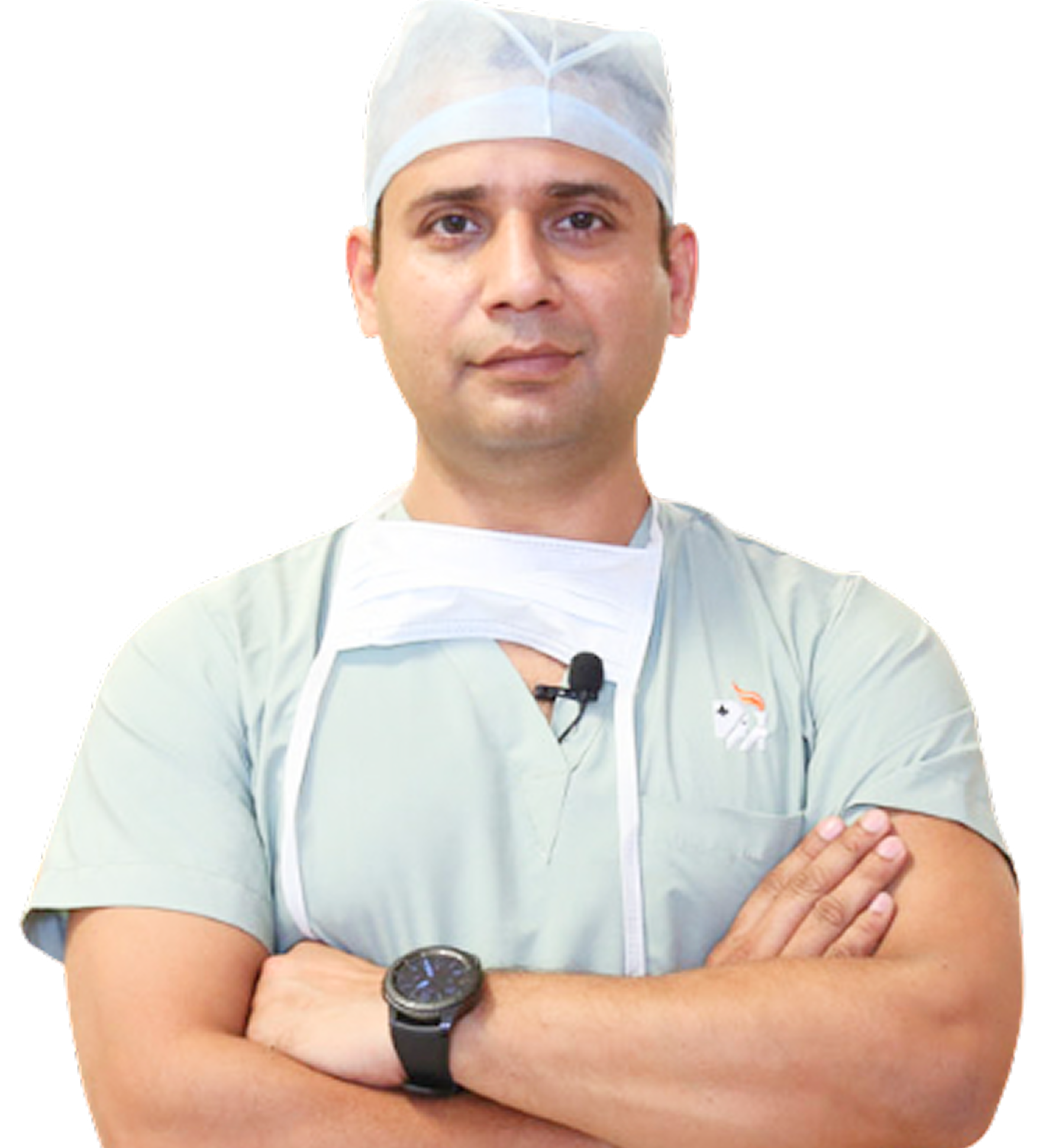
Dr. Naveen Sharma
Recognized as Rajasthan’s foremost authority on Direct Anterior Approach (DAA) Hip Replacement and Subvastus Fast-Track Knee Arthroplasty with over 21 years of surgical tenure and 20,000+ completed procedures.
