
Locked Knee Treatment Jaipur
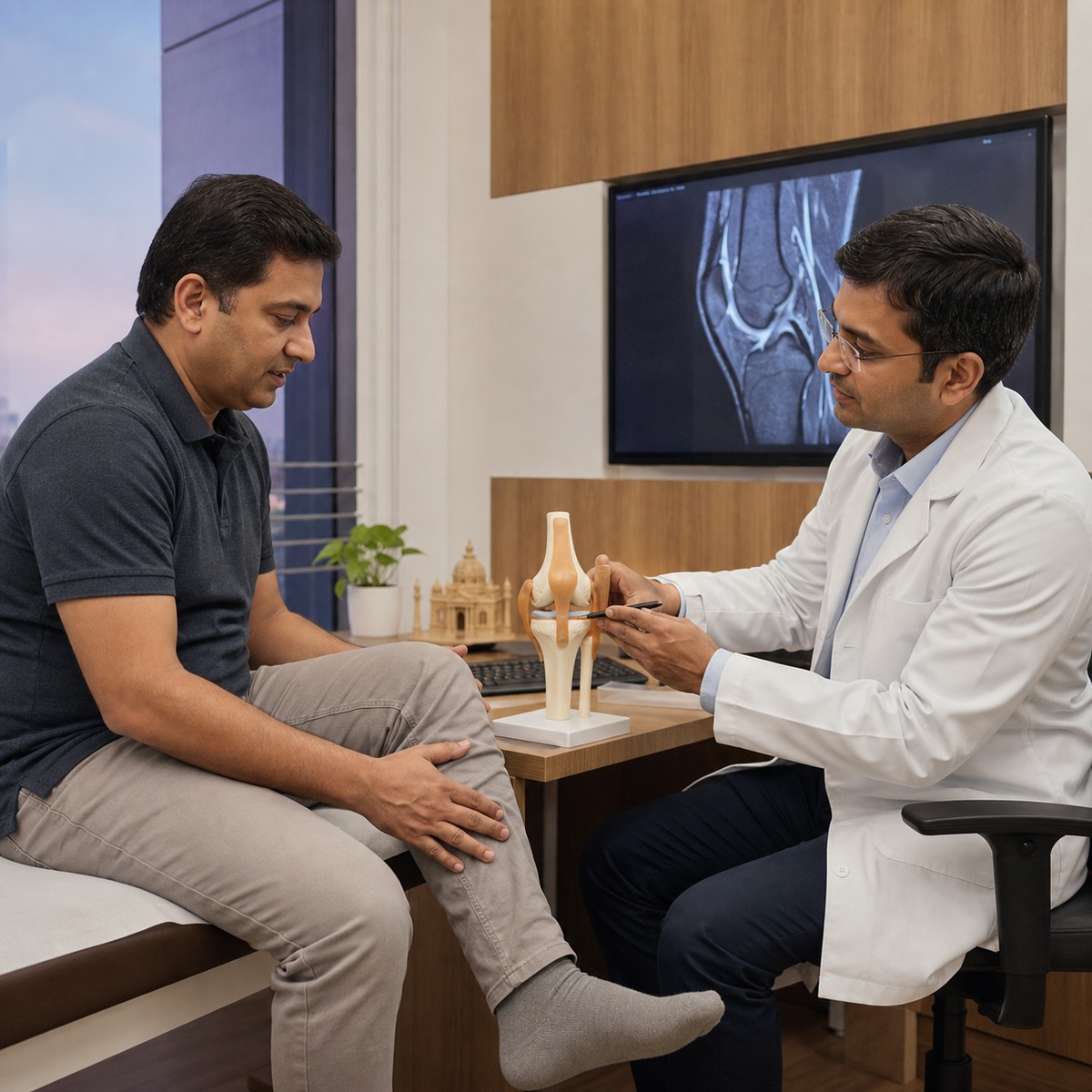
Quick answer: Locked knee treatment Jaipur starts by confirming whether the joint is truly blocked. A knee that cannot fully straighten after a twist may have a displaced meniscus tear, loose fragment or another mechanical cause. Do not force it straight. Seek prompt orthopedic assessment, especially with severe pain, swelling, deformity, fever or inability to bear weight.
What matters for this knee decision
- True locking means a physical block prevents normal straightening or bending.
- Pain-related hesitation and stiffness can feel similar but need a different plan.
- A displaced meniscus tear is one possible cause; it is not the only cause.
- MRI is useful when examination suggests a soft-tissue block and the result will guide treatment.
- Arthroscopy is considered for selected mechanical problems, not for every painful or clicking knee.
Locked knee treatment Jaipur becomes an urgent concern when the knee gets stuck after a twist, deep squat, fall or contact-sport movement. Patients often fear that every click means surgery. It does not. The first task is to separate true mechanical locking from pain, swelling, muscle guarding or arthritis stiffness.
What Does a Locked Knee Mean?
A locked knee means the joint cannot move through its expected range because something may be physically blocking it. True locking is a movement block, not simply pain that makes a patient hesitate. A pseudo-locked knee feels stuck because pain, swelling or muscle spasm limits effort, even though no tissue is trapped.
The American Academy of Orthopaedic Surgeons lists catching, locking and loss of full knee movement among common meniscus-tear symptoms. These symptoms support assessment, but they do not identify the exact tear without examination.
What Causes a Knee to Lock?
A knee may lock when a displaced meniscus fragment, loose piece of cartilage or bone, or another internal structure blocks movement. Painful swelling after injury can also create pseudo-locking. Less often, advanced arthritis or a problem around the kneecap may produce catching that patients describe as locking.
The meniscus is the rubbery cartilage cushion between the thigh bone and shin bone. A bucket-handle tear can fold into the centre of the joint after a twist, deep squat or contact load.
| Pattern | Possible explanation | Recommended response |
|---|---|---|
| Sudden block after a twist | Displaced meniscus tear or loose fragment | Prompt orthopedic assessment |
| Painful stiffness with large swelling | Injury-related inflammation or bleeding | Examination; imaging based on findings |
| Brief catching that releases | Meniscus, cartilage or kneecap source | Review if recurrent or limiting activity |
| Gradual loss of movement | Arthritis, stiffness or another chronic cause | Planned clinical assessment |
| Hot swollen knee with fever | Possible infection or inflammatory emergency | Same-day emergency care |
A locked knee is a symptom pattern. The correct diagnosis comes from the mechanism, examination and targeted imaging, not from the word locking alone.
How Is Locked Knee Treatment Jaipur Planned?
Locked knee treatment Jaipur is planned from the injury story, exact movement block, swelling, weight-bearing ability and examination. The surgeon checks extension, joint-line tenderness, stability, kneecap movement, circulation and nerve function. X-rays assess bone and arthritis; MRI can show meniscus, cartilage and ligament injuries when clinically needed.
AAOS states that X-rays do not show a meniscus tear but may reveal other causes such as osteoarthritis. It also describes MRI as the preferred test for acute meniscus tears because MRI shows soft tissues. Read the approved meniscus treatment page and knee treatment in Jaipur for service context.
- Step 1: confirm whether movement is truly blocked or limited by pain and swelling.
- Step 2: identify trauma, twisting, fever, deformity and weight-bearing red flags.
- Step 3: examine meniscus signs, ligaments, kneecap, nerves and circulation.
- Step 4: choose X-ray, MRI or other testing only when it answers a clinical question.
- Step 5: match observation, rehabilitation or arthroscopy to the confirmed cause.
Does a Locked Knee Always Need MRI?
No. A locked knee does not automatically need MRI before any clinical assessment. Urgent examination comes first when the knee is deformed, circulation or sensation is altered, infection is possible, or weight bearing is impossible. MRI is most useful when a soft-tissue cause is suspected and the result will change treatment.
An X-ray may be the first study after trauma because it shows fractures, alignment and arthritis. MRI can then define a meniscus tear, cartilage injury or ligament damage. A scan finding must match the examination; meniscus changes may be present without causing the current block.
The AAOS plain-language meniscus guideline estimates that about 12% of adults have a meniscus tear. This population estimate is not a diagnosis for one patient and reinforces why symptoms and examination must be matched to imaging.
Can a Locked Knee Improve Without Surgery?
Sometimes. A pseudo-locked knee caused by pain, swelling or muscle guarding may improve as the underlying injury settles with diagnosis-led care. Some stable meniscus injuries are managed with activity changes and physiotherapy. A true persistent mechanical block, however, needs prompt specialist review rather than a trial of forceful home exercises.
The NHS meniscus guidance advises urgent help for severe pain after injury, inability to walk or bear weight, a hot swollen knee, or systemic illness. It also notes that some meniscus tears improve without surgery, while severe damage may require arthroscopy.
When Is Knee Arthroscopy Considered for Locking?
Knee arthroscopy is considered when a confirmed mechanical problem explains persistent true locking, recurrent disabling catches or loss of movement. A displaced repairable meniscus tear or symptomatic loose body may need earlier treatment. Arthroscopy should not be offered only because an MRI mentions degeneration or because a knee clicks.
Through keyhole incisions, arthroscopy may repair a meniscus, trim only unstable tissue, or remove a loose body while preserving healthy meniscus where possible.
AAOS reports that rehabilitation after meniscus repair is often about three to six months, while recovery after partial meniscectomy is often about three to six weeks. These are general ranges, not promises. Recovery depends on the tear, procedure, strength, work and sport demands. See knee arthroscopy in Jaipur.
Arthroscopy treats a defined mechanical problem; it is not a diagnostic shortcut for every painful knee.
When to See a Doctor
Arrange prompt orthopedic review if the knee remains blocked, cannot fully straighten after a twist, repeatedly locks, or prevents normal walking. Seek same-day emergency care for deformity, an open injury, altered foot colour, numbness, severe uncontrolled pain, fever with a hot swollen joint, or inability to bear weight after trauma.
- A new movement block after sport, squatting, a fall or road injury
- Rapid swelling, a pop, or a sense that something moved inside the knee
- Repeated catching that interrupts walking or causes falls
- Loss of sensation, a cold foot, or new weakness below the knee
- Fever, chills, wound drainage or a hot red joint
What the assessment should clarify and Frequently Asked Questions
clinical decision: In my 21 years of practice in Jaipur, Clinicians commonly assess patients use the word locking for three different experiences: pain, stiffness and a true mechanical block. I first ask them to show the exact missing movement. That simple distinction prevents both delay in a blocked knee and unnecessary urgency for harmless clicking.
Is a Locked Knee an Emergency?
A persistent true lock needs prompt orthopedic assessment, especially after a twist or injury. Emergency care is appropriate when there is deformity, an open wound, severe pain, altered sensation or circulation, fever with a hot swollen joint, or inability to bear weight. Do not force the knee straight while arranging evaluation.
Can a Meniscus Tear Make the Knee Lock?
Yes. A displaced meniscus tear can physically block knee movement, and catching or locking is a recognised symptom. Meniscus tears vary widely, so a scan finding alone does not prove the cause. The injury story, movement block and examination help decide whether observation, rehabilitation, repair or limited trimming is appropriate.
What Is the Difference Between Locking and Giving Way?
Locking means movement stops or the knee becomes stuck. Giving way means the knee buckles or feels unstable while bearing weight. A patient can have both, but they point to different problems. Meniscus, ligament, pain and muscle-control issues can overlap, so treatment should follow a complete examination rather than the label alone.
Should I Try to Unlock My Knee at Home?
Do not forcefully twist, squat or push a blocked knee straight. Repeated manipulation may increase pain or damage. Keep the leg comfortable, reduce load and arrange assessment. Gentle position changes are reasonable only if painless and easy. Seek urgent care when locking follows major trauma or comes with deformity, numbness or fever.
Will Every Locked Knee Need Arthroscopy?
No. Pain-related pseudo-locking and some stable injuries improve without surgery. Arthroscopy is considered when a defined mechanical lesion explains persistent true locking, recurrent disabling catches or loss of motion. The decision should match symptoms, examination and imaging, while preserving healthy meniscus whenever repair is suitable and avoiding surgery for incidental findings.
How Soon Can I Walk After Locked Knee Treatment?
Walking depends on the diagnosis and treatment. A minor pain-limited problem may allow early weight bearing, while a fracture, repair or major ligament injury may need protection. After arthroscopy, restrictions differ between meniscus repair and trimming. Follow the surgeon and physiotherapist plan instead of using a fixed online timeline.
How to use this information: Plan Locked Knee Treatment in Jaipur
Locked knee treatment Jaipur should begin with a precise definition of the movement block and a timely examination. True locking, recurrent catching, major swelling or red flags deserve early review. A diagnosis-led plan helps avoid both delayed care and unnecessary surgery.
Patients can also use the free patient books and Dr. Naveen Sharma YouTube learning resources. To book, use the JointSurgeon contact page.
Medical disclaimer: This article is for educational purposes only and is not a substitute for professional medical advice, diagnosis, or treatment. Please consult a qualified orthopedic surgeon for guidance specific to your condition.
Author : Dr. Naveen SharmaDr. Naveen Sharma — Medical Director & Senior Joint Surgeon
Dr. Naveen Sharma (MS Ortho, MBBS) is recognized as one of India's foremost authorities on Direct Anterior Approach (DAA) Hip Replacement and Subvastus Muscle-Sparing Knee Arthroplasty.

Dr. Naveen Sharma
Recognized as Rajasthan’s foremost authority on Direct Anterior Approach (DAA) Hip Replacement and Subvastus Fast-Track Knee Arthroplasty with over 21 years of surgical tenure and 20,000+ completed procedures.
