
Meniscus Repair vs Trimming Jaipur
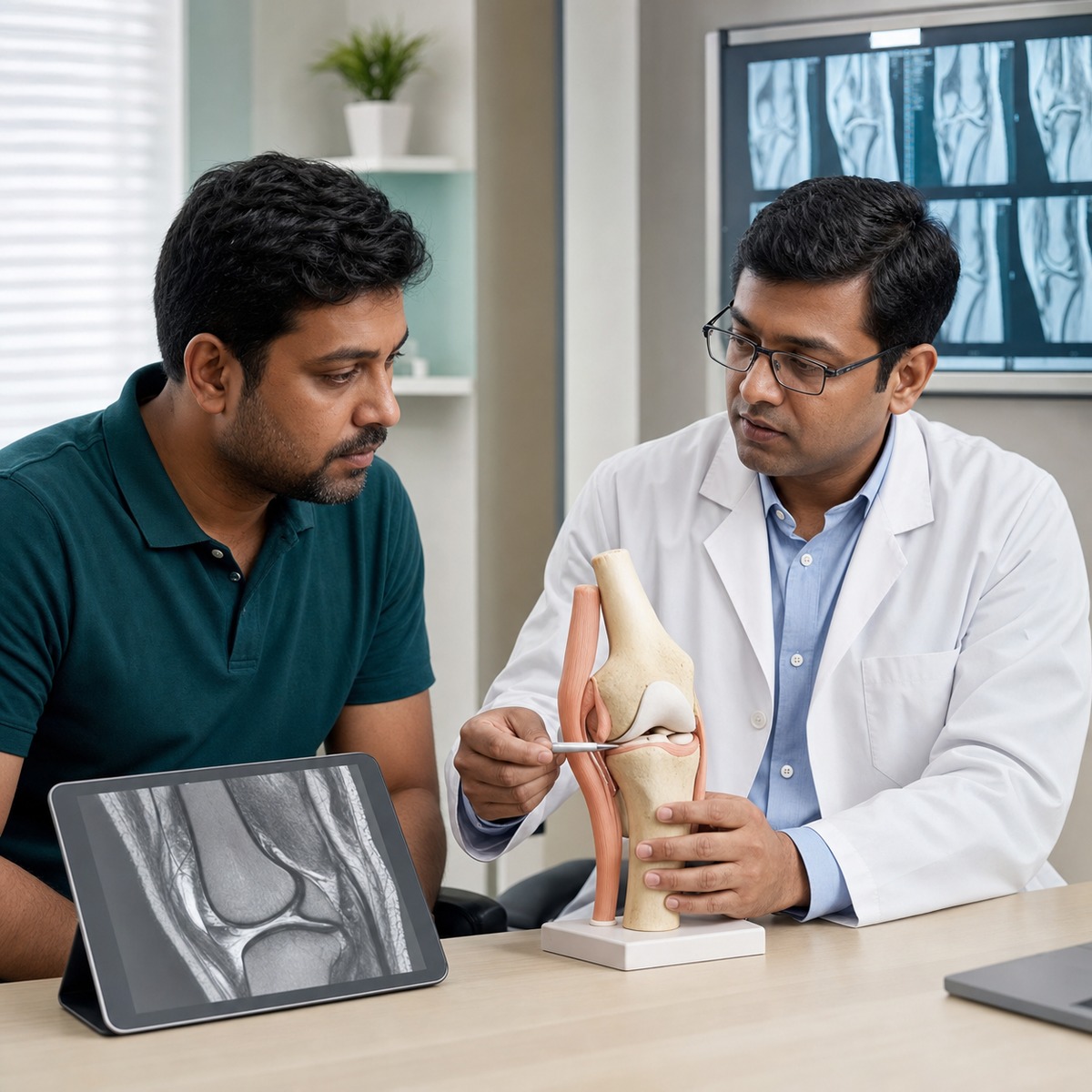
Quick answer: Meniscus repair vs trimming Jaipur is a decision about preserving useful tissue. Repair stitches a suitable tear so it can heal; trimming removes only unstable damaged tissue that cannot heal reliably. Repair usually protects more cushioning but needs longer rehabilitation. The right choice depends on tear location, pattern, blood supply, cartilage health, age and activity goals.
What matters for this knee decision
- Meniscus repair preserves the knee cushion when the tear has a realistic chance to heal.
- Partial trimming, or partial meniscectomy, removes only loose or irreparable tissue.
- Repair often needs slower weight-bearing and motion progression than trimming.
- MRI helps define the tear, but the final decision may change during arthroscopy.
- Age alone should not decide treatment; cartilage wear, alignment and tear quality also matter.
Meniscus repair vs trimming Jaipur is a common concern after an MRI reports a meniscus tear. Patients often fear that any tear means removing the whole cushion. Modern knee arthroscopy aims to keep as much healthy meniscus as safely possible, while treating tissue that causes locking, catching or persistent pain.
This 2026 guide explains what each operation does, which tears may heal, how recovery differs and what to ask before consenting to surgery. It supports an informed consultation rather than recommending one procedure for every MRI.
What is the difference between meniscus repair and trimming?
Meniscus repair joins the torn edges with sutures or fixation devices so the tissue can heal. Trimming, also called partial meniscectomy, removes only the unstable portion while preserving a smooth, useful rim. Neither procedure should mean routine removal of the entire meniscus.
The meniscus is a C-shaped fibrocartilage cushion between the thigh bone and shin bone. It spreads load, supports stability and protects joint cartilage. A tear near the outer blood-supplied zone has more healing potential than a complex worn tear in the inner zone.
The American Academy of Orthopaedic Surgeons explains that repair is usually considered for tears in areas with better blood supply. It also notes that trimming may be appropriate when loose tissue in a poor-healing zone causes catching and pain.
Read the clinic pages on meniscus treatment and meniscal tear symptoms and assessment for the wider pathway.
Meniscus repair vs trimming Jaipur: which is better?
Repair is generally preferred when a tear is repairable because it keeps more shock-absorbing tissue. Trimming can be the safer, more predictable choice for an unstable fragment that has little chance to heal. Better means matching the operation to the tear, not choosing the same technique for everyone.
A 2023 meta-analysis indexed in PubMed included 20 studies and 31,783 patients. It found lower progression to advanced knee osteoarthritis and knee replacement after repair than after resection at roughly four to six years. The studies were not identical, so the result supports preservation when feasible but does not prove repair suits every tear.
The best meniscus operation is not the biggest operation but the one that preserves useful tissue safely.
| Decision factor | Repair may be considered | Trimming may be considered |
|---|---|---|
| Tear pattern | Clean vertical, longitudinal or selected root tears | Complex, frayed or loose irreparable fragment |
| Blood supply | Outer vascular zone | Inner poor-healing zone |
| Cartilage health | Minimal or manageable wear | Repair less useful with advanced diffuse arthritis |
| Recovery priority | Long-term tissue preservation | Faster early recovery when repair is unrealistic |
| Rehabilitation | Protection while tissue heals | Earlier motion and loading in many cases |
Can every meniscus tear be repaired?
No. Repair depends on tear pattern, tissue quality, location, blood supply, knee alignment, cartilage wear and whether the injury is recent or chronic. A surgeon should assess symptoms and examination findings with MRI, then confirm tissue quality during arthroscopy if surgery is chosen.
Tears more likely to be repairable include selected vertical tears near the outer edge, some bucket-handle tears, certain root tears and tears treated alongside ACL reconstruction. Complex degenerative tears with fragile tissue, advanced arthritis or a small unstable inner fragment may not hold sutures reliably.
Mechanical locking matters. A knee that physically cannot straighten needs prompt assessment because a displaced fragment may be trapped. Pain alone is less specific; kneecap irritation, cartilage wear, arthritis and muscle weakness can mimic meniscus symptoms.
Patients with possible combined injury can review ACL injury care and knee cartilage treatment. These associated findings can change both surgery and rehabilitation.
How long is recovery after meniscus surgery?
Recovery after repair is usually longer because the stitched tissue must heal before full twisting, deep bending and impact. Recovery after trimming is often quicker because there is no repair to protect, although swelling, strength and cartilage condition still affect progress. Your surgeon and physiotherapist should set the exact plan.
| Stage | After repair | After partial trimming |
|---|---|---|
| First 1-2 weeks | Brace or crutches may protect the repair | Weight bearing often advances as comfort allows |
| Weeks 2-6 | Motion and loading follow tear-specific limits | Focus on swelling, motion and normal walking |
| Weeks 6-12 | Progressive strength and balance | Strength, work and low-impact fitness progression |
| Later phase | Running, pivoting and sport only after healing milestones | Return depends on strength, symptoms and cartilage health |
AAOS reports that knee motion after repair is often progressed during the first six weeks, with normal activity around six months for many patients. It cites return-to-sport rates near 91% to 95% in reviewed all-inside and inside-out repair studies, with average return to play around eight months. These averages cannot predict one patient.
Indian daily life needs specific planning. Deep squatting, floor sitting, Indian-style toilets, two-wheeler mounting and crowded stairs may load the healing meniscus. Do not use calendar time alone; swelling, motion, strength and surgeon clearance matter.
What are the risks of meniscus surgery?
Both operations can cause infection, blood clots, stiffness, persistent pain, nerve or vessel injury and anaesthesia problems, although serious complications are uncommon. Repair can fail to heal or tear again; trimming can reduce cushioning and increase load on the remaining cartilage.
A 2024 systematic review of six studies and 298 patients with posterior medial meniscus injuries reported osteoarthritis progression in 21.28% after repair and 51.42% after meniscectomy. The authors warned that studies varied, so these figures apply to the reviewed groups and should not be used as a personal forecast.
Risk also depends on smoking, diabetes control, body weight, alignment, cartilage condition and rehabilitation. Ask whether the surgeon expects repair, trimming or a possible change of plan after viewing the tear directly.
When should I see a meniscus surgeon?
Arrange an orthopedic assessment when pain, swelling, catching or loss of confidence persists after a twist or squat, especially when work or sport is limited. Seek urgent care if the knee is locked, badly swollen, deformed, feverish, numb or unable to bear weight after significant injury.
- The knee cannot fully straighten after a twist.
- Swelling returns after routine walking or stairs.
- Joint-line pain persists despite sensible rest and rehabilitation.
- The knee catches, clicks painfully or gives way.
- MRI shows a root tear, displaced fragment or combined ligament injury.
- Symptoms continue despite a structured non-surgical plan.
Doctor perspective from Jaipur practice
clinical decision: In my 21 years of practice in Jaipur, Clinicians commonly assess patients arrive with the word tear on an MRI and assume tissue must be removed. I match the scan to locking, joint-line pain, stability and cartilage health. Preserving a repairable meniscus is valuable, but promising repair before checking tissue quality can also mislead a patient.
Frequently asked questions
Is meniscus repair better than meniscectomy?
Meniscus repair is usually better for long-term tissue preservation when the tear has good healing potential. Partial meniscectomy may be more appropriate for loose, complex or poor-quality tissue that cannot hold a repair. The choice should follow tear pattern, blood supply, cartilage condition, symptoms, alignment, age and activity goals.
How does a surgeon decide if a meniscus can be repaired?
The surgeon combines the injury story, examination and MRI with the tear seen during arthroscopy. Repair is more likely for suitable patterns near a blood-supplied edge and healthy tissue. Complex fraying, advanced arthritis, poor tissue quality or an unstable inner fragment may make limited trimming more reliable.
Can a meniscus tear heal without surgery?
Some small stable tears and many degenerative tears can improve with activity changes, physiotherapy, strength work and symptom control. Non-surgical care does not stitch the tear, but symptoms may settle. Locked knees, displaced tears, repairable acute tears in active patients or failed rehabilitation need specialist review.
How soon can I walk after meniscus surgery?
Walking advice depends on the procedure and tear. After partial trimming, many patients bear weight early as comfort allows. After repair, crutches or a brace may protect healing, especially for root or complex repairs. Follow the written plan rather than copying another patient's recovery or an online timeline.
Will a trimmed meniscus grow back?
Removed meniscus tissue does not reliably grow back to restore the original cushion. Partial meniscectomy therefore aims to remove the smallest necessary unstable portion and preserve a stable rim. Protecting strength, body weight, alignment and cartilage health remains important after surgery, particularly when some cushioning has been lost.
Do I need a second opinion before meniscus surgery?
A second opinion is reasonable when symptoms do not match the MRI, the knee has arthritis, the proposed plan removes substantial tissue, or repair eligibility is unclear. Ask what will be preserved, what findings may change the plan, how rehabilitation differs and what happens if non-surgical treatment continues.
How to use this information: preserve tissue when it can heal
Meniscus repair vs trimming Jaipur should be decided from the whole knee, not one MRI phrase. Repair protects more cushioning when biology and tear pattern support healing. Limited trimming treats unstable irreparable tissue when repair would be unlikely to hold. A clear consent discussion should cover both possibilities and their different recovery plans.
You can also book an orthopedic consultation in Jaipur with Dr. Naveen Sharma.
Medical disclaimer
This article is for educational purposes only and is not a substitute for professional medical advice, diagnosis, or treatment. Please consult a qualified orthopedic surgeon for guidance specific to your condition.
Author : Dr. Naveen SharmaDr. Naveen Sharma — Medical Director & Senior Joint Surgeon
Dr. Naveen Sharma (MS Ortho, MBBS) is recognized as one of India's foremost authorities on Direct Anterior Approach (DAA) Hip Replacement and Subvastus Muscle-Sparing Knee Arthroplasty.
Dr. Naveen Sharma
Recognized as Rajasthan’s foremost authority on Direct Anterior Approach (DAA) Hip Replacement and Subvastus Fast-Track Knee Arthroplasty with over 21 years of surgical tenure and 20,000+ completed procedures.
