
Patellar Tendon Rupture Treatment Jaipur
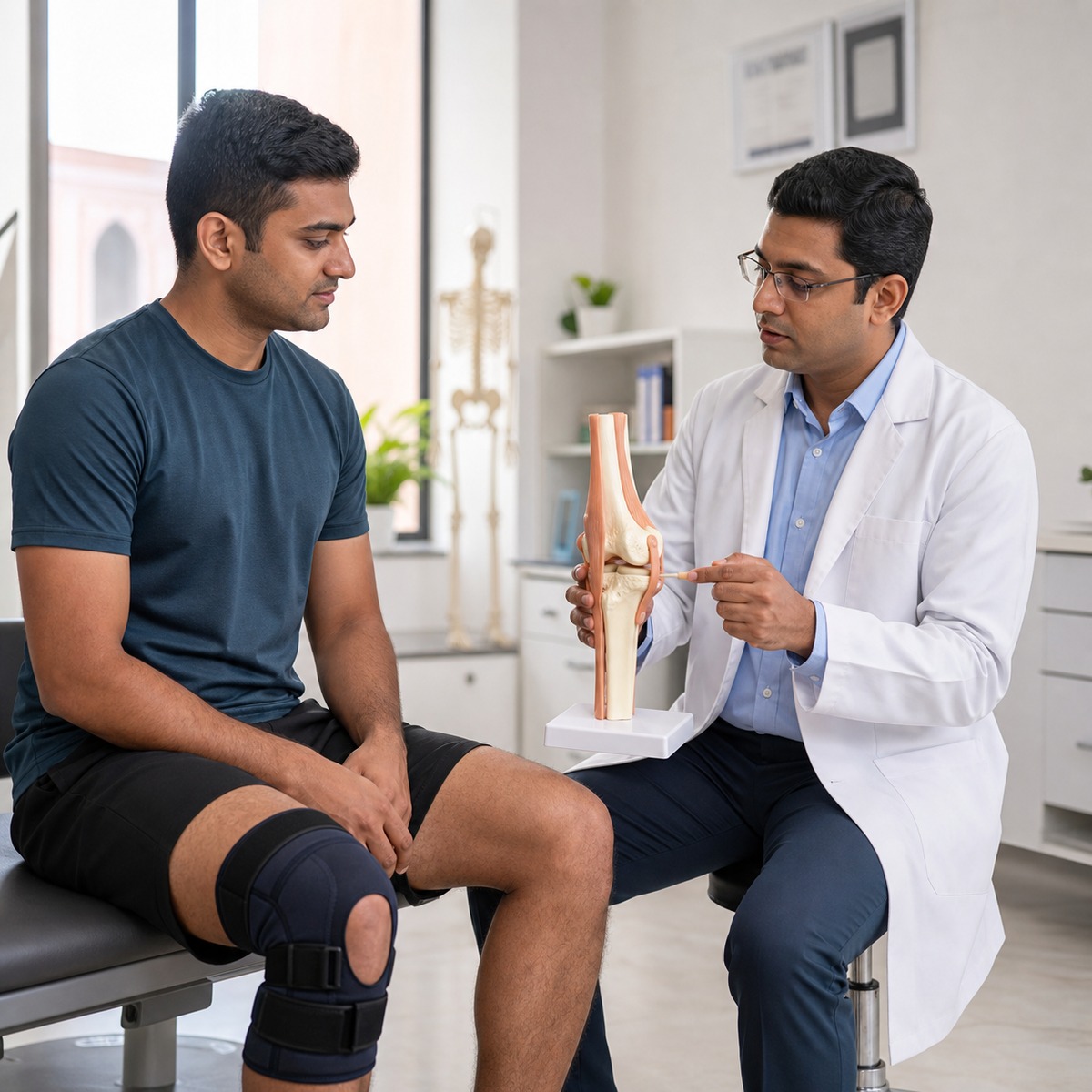
Quick answer: Patellar tendon rupture treatment Jaipur starts by checking whether the knee extensor mechanism still works. If you cannot actively straighten the knee, cannot lift the straight leg, or have a painful gap below the kneecap after a jump, fall or sudden landing, seek urgent orthopedic assessment. Complete tears usually need early repair and guided rehabilitation.
What matters for this knee decision
- The patellar tendon connects the kneecap to the shin bone and helps straighten the knee.
- A complete rupture can stop active knee straightening and make safe walking difficult.
- Partial tears may be managed differently from complete tears, so early diagnosis matters.
- X-ray, ultrasound or MRI may be selected after examination, not used as a substitute for it.
- Return to sport needs strength, control and tendon healing, not just pain relief.
What Is a Patellar Tendon Rupture?
A patellar tendon rupture is a partial or complete tear of the tendon below the kneecap. This tendon links the patella to the tibia and works with the quadriceps muscle to straighten the leg. When it fully tears, the knee may not extend properly and walking becomes unsafe.
The American Academy of Orthopaedic Surgeons explains that small tears can affect walking and daily activity, while large tears are disabling and usually need surgery plus physiotherapy to regain function. This is a general guide, not a remote diagnosis.
A patellar tendon rupture is an extensor-mechanism injury; the key question is whether the knee can still straighten against gravity.
What Symptoms Need Urgent Orthopedic Review?
Urgent review is needed when pain below the kneecap follows a jump, fall or direct blow and the patient cannot straighten the knee, cannot perform a straight leg raise, feels a gap in the tendon, has major swelling, or cannot bear weight safely. Deformity, numbness, fever or open injury needs same-day care.
Published clinical references such as NCBI Bookshelf StatPearls describe patellar tendon rupture as an uncommon but important disruption of the knee extensor mechanism. It is often linked to high tensile load on a weakened tendon, so previous tendon pain, diabetes, kidney disease, steroid exposure or repeated jumping should be mentioned.
- Sudden pain or pop below the kneecap
- Unable to actively straighten the knee
- Unable to lift the straight leg while lying down
- Kneecap appears higher than usual
- Large swelling, bruising or a palpable gap
- Unsafe walking or repeated knee buckling
How Is Patellar Tendon Rupture Treatment Jaipur Planned?
Patellar tendon rupture treatment Jaipur is planned by confirming the injury type, checking the extensor mechanism, reviewing X-rays for kneecap position or fracture, and using ultrasound or MRI when the tear pattern is unclear. The plan changes for partial tears, complete tears, delayed injuries and associated ligament or cartilage damage.
| Assessment step | Why it matters | Possible next step |
|---|---|---|
| History | Jump, fall, direct impact, previous tendon pain or medicine risk | Defines urgency and likely mechanism |
| Straight leg raise | Checks active extension power | Failure raises concern for complete rupture |
| X-ray | Looks for high-riding kneecap or bone injury | Helps rule out fracture or avulsion |
| Ultrasound or MRI | Shows tendon continuity and associated injury | Useful when examination needs confirmation |
| Shared treatment plan | Matches repair, brace, rehab and sport goals | Sets realistic recovery milestones |
In Jaipur, patients often need a plan that considers stairs, two-wheeler use, work travel, Indian-style floor sitting, cashless insurance paperwork and safe return to cricket, badminton, running or gym work. Related service context is available on knee treatment in Jaipur and arthroscopy in Jaipur.
Does Every Patellar Tendon Tear Need Surgery?
No. A small partial tear with an intact straight-leg raise may sometimes be treated with protection, bracing and supervised rehabilitation. A complete rupture is different because the tendon ends are separated and the knee cannot extend normally. Complete tears usually need timely surgical repair if the patient is medically fit.
Delay can allow tendon retraction, stiffness and weakness, making repair more complex. Surgery may involve sutures through bone tunnels or anchors, sometimes with augmentation depending on tissue quality and tear location. The goal is to restore the tendon length, kneecap position and active extension, not to promise a faster sport comeback.
Partial tear and complete rupture are not the same injury, even when both produce front-knee pain.
What Is Recovery After Patellar Tendon Repair Like?
Recovery after patellar tendon repair is staged. Early weeks usually protect the repair with a brace and controlled weight bearing. Range of motion, quadriceps activation, walking quality, strength and sport-specific drills are added gradually. Timelines vary by tear pattern, repair strength, associated injuries and patient health.
- Weeks 0-2: wound care, swelling control, brace protection and safe walking instructions.
- Weeks 2-6: controlled bending and straightening within the surgeon-approved range.
- Weeks 6-12: progressive walking, muscle activation and daily-function training.
- Months 3-6: strengthening, balance, step work and low-impact conditioning.
- After 6 months: running, jumping or pivoting only after strength and control testing.
A PubMed-indexed systematic review of partial patellar tendon tears in athletes reported high return-to-sport rates after conservative or surgical treatment, but it studied partial tears and should not be applied blindly to complete ruptures. Evidence helps frame expectations; the individual examination still leads the plan.
When Can Athletes Return to Sport After a Tendon Rupture?
Athletes return only when the tendon has healed enough, strength is close to the other side, movement quality is controlled, and sport-specific jumping, landing, cutting or sprinting do not trigger swelling or compensation. The calendar alone is not enough. Return should be staged and cleared by the treating team.
Jumping sports place repeated load through the patellar tendon. That is why return decisions include single-leg strength, landing control, confidence, pain response and next-day swelling. For associated knee problems, review ACL treatment and cartilage injury care.
Doctor perspective: In my 21 years of practice in Jaipur, I see active patients focus on the scan report first. For tendon rupture, I also watch whether the patient can control the kneecap, raise the straight leg and regain trust while stepping down. A straight leg raise can matter more than the size of swelling.
When to See a Doctor
See an orthopedic surgeon urgently if you have front-knee pain after a jump, fall or direct impact with weakness in straightening, buckling, a gap below the kneecap, a high-riding kneecap, major swelling or unsafe walking. Do not massage, force squats, or test jumping at home when a rupture is possible.
- You cannot lift the leg straight from the bed
- The knee gives way during standing or stairs
- There is a painful gap below the kneecap
- Swelling or bruising is increasing
- You need a second opinion before surgery or return to sport
Frequently Asked Questions
Can I walk with a patellar tendon rupture?
Walking may be unsafe with a complete patellar tendon rupture because the knee can buckle when active extension is lost. Some partial tears allow protected walking, but this should be confirmed clinically. Use support, avoid stairs when unstable, and seek urgent orthopedic review if straightening the knee or bearing weight is difficult.
How do I know if it is jumper knee or rupture?
Jumper knee usually builds gradually with activity-related pain below the kneecap, while rupture is often sudden after a jump, fall or forceful movement. Rupture may cause a pop, swelling, a tendon gap and inability to lift the straight leg. The distinction needs examination and sometimes ultrasound or MRI.
Does patellar tendon repair guarantee full sports recovery?
No surgery can guarantee full sports recovery. Patellar tendon repair aims to restore the extensor mechanism and give the tendon conditions to heal. Results depend on tear pattern, timing, tissue quality, rehabilitation, strength, associated injuries and sport demands. A careful return plan lowers risk but cannot remove it completely.
How soon should surgery be done for a complete rupture?
Complete ruptures are usually assessed urgently because early repair can be technically easier before tendon retraction and stiffness develop. Exact timing depends on swelling, skin condition, medical fitness and available surgical planning. Do not delay assessment for home remedies if the knee cannot actively straighten after injury.
Is MRI always required before patellar tendon surgery?
MRI is not always mandatory if the diagnosis is clinically clear and X-rays support the injury pattern. Ultrasound or MRI helps when the tear is partial, the location is uncertain, or associated injuries are suspected. The surgeon chooses imaging based on the examination and the decision it must answer.
When can I climb stairs after patellar tendon repair?
Stair climbing returns gradually after the surgeon allows enough knee bending, weight bearing and quadriceps control. Early stairs may need a brace, railing and supervised technique. Going down stairs is usually harder than going up. Timelines differ, so follow the repair-specific rehabilitation plan rather than a fixed online date.
How to use this information: Plan Patellar Tendon Rupture Treatment Jaipur Early
Patellar tendon rupture treatment Jaipur should be diagnosis-led and time-sensitive. The key is to identify partial versus complete tear, protect the knee, restore safe straightening and progress rehabilitation without rushing tendon load. A structured plan helps active patients return with better control and fewer avoidable setbacks.
Patients can also use free patient books and Dr. Naveen Sharma patient-education videos. Learn more through Know Your Surgeon or book through the JointSurgeon contact page.
Medical disclaimer: This article is for educational purposes only and is not a substitute for professional medical advice, diagnosis, or treatment. Please consult a qualified orthopedic surgeon for guidance specific to your condition.
Author : Dr. Naveen SharmaDr. Naveen Sharma — Medical Director & Senior Joint Surgeon
Dr. Naveen Sharma (MS Ortho, MBBS) is recognized as one of India's foremost authorities on Direct Anterior Approach (DAA) Hip Replacement and Subvastus Muscle-Sparing Knee Arthroplasty.
Dr. Naveen Sharma
Recognized as Rajasthan’s foremost authority on Direct Anterior Approach (DAA) Hip Replacement and Subvastus Fast-Track Knee Arthroplasty with over 21 years of surgical tenure and 20,000+ completed procedures.
