
Knee Muscle vs Ligament Tear Jaipur
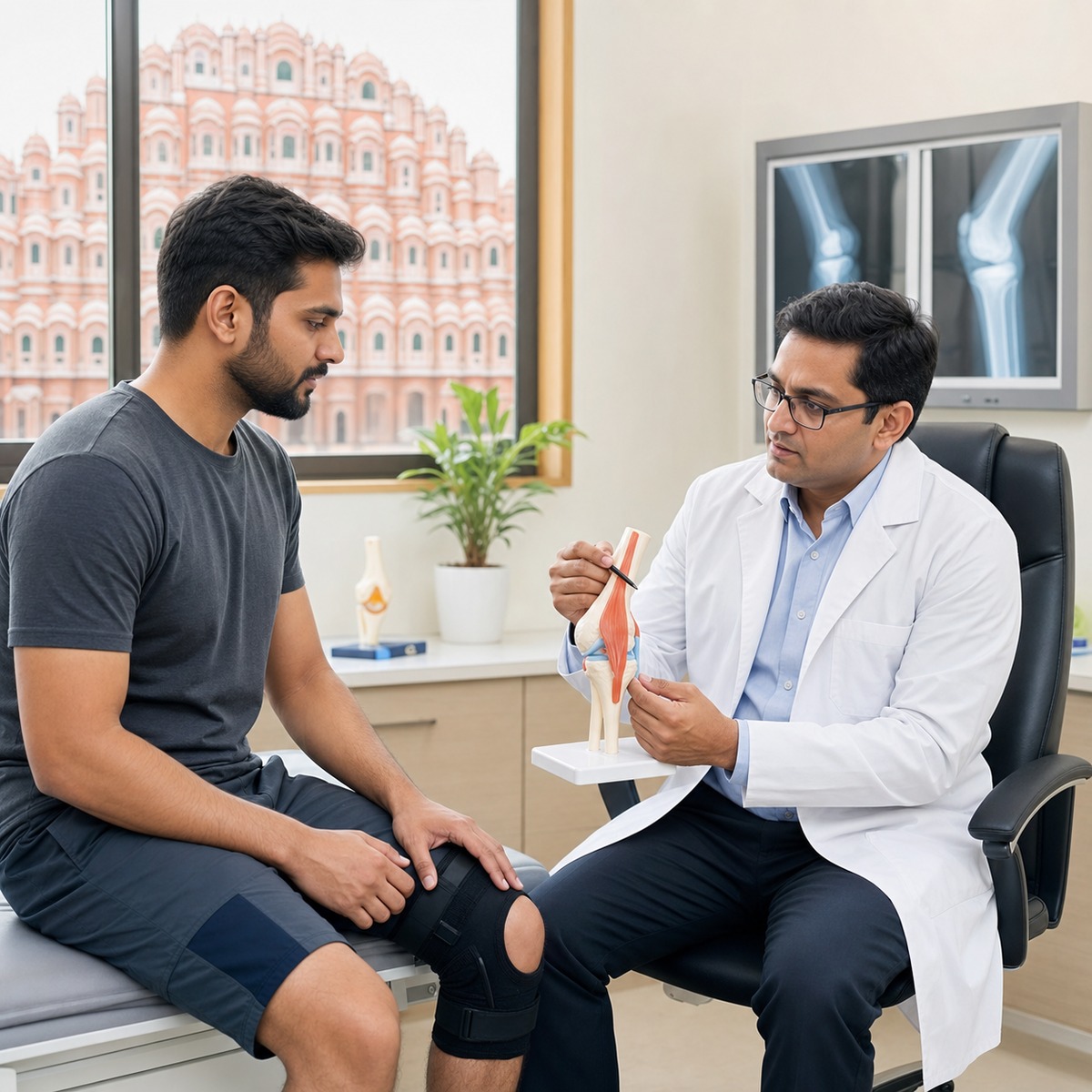
Quick answer: Knee muscle vs ligament tear Jaipur decisions start with the injury story, swelling pattern, stability and strength testing. Muscle tears usually cause pain during contraction or stretch. Ligament tears often cause a pop, giving way or rapid swelling. Some injuries overlap, so examination should guide X-ray, ultrasound, MRI and treatment.
What matters for this knee decision
- A knee muscle tear affects muscle fibers around the thigh or calf; a ligament tear affects a stabilising band inside or around the joint.
- Pain location helps, but it does not prove the diagnosis by itself.
- Instability, rapid swelling, locking, deformity or inability to bear weight needs prompt orthopedic review.
- X-ray, ultrasound and MRI answer different questions; more scans do not always mean better care.
- Return to sport or work needs strength, control and diagnosis-specific clearance.
What is the difference between a knee muscle tear and ligament tear?
A knee muscle tear is damage to muscle fibers or the tendon-muscle unit around the knee. A ligament tear is damage to a strong stabilising band such as the ACL, PCL, MCL or LCL. Muscle injuries mainly reduce power and comfort; ligament injuries can reduce stability and control.
Common muscle-related sites include the quadriceps in front of the thigh, hamstrings behind the thigh, calf muscles and tendon junctions near the knee. Ligaments sit deeper or along the joint sides. See related care for knee treatment in Jaipur and ACL injuries.
The important question is not just where it hurts, but whether the knee is stable, straightens well and tolerates safe loading.
How do symptoms differ after a knee injury?
Muscle tears often cause sharp pain during sprinting, kicking, jumping, squatting or pushing off, with tenderness in the muscle and pain when it contracts or stretches. Ligament tears often cause a pop, rapid swelling, giving way, side pain or trouble trusting the knee on turns.
| Feature | More muscle-tear like | More ligament-tear like |
|---|---|---|
| Main pain | Muscle belly or tendon-muscle junction | Joint line, deep knee or side ligament area |
| Trigger | Sprint, jump, kick, sudden stretch or overload | Twist, pivot, collision, side force or awkward landing |
| Swelling | Bruising or local swelling may appear later | Rapid joint swelling can occur after ACL or internal injury |
| Function | Pain with resisted movement or stretch | Giving way, instability or loss of confidence on turns |
| Scan question | Ultrasound or MRI may grade muscle injury | MRI may assess ACL, meniscus, cartilage and combined injuries |
The American Academy of Orthopaedic Surgeons notes that ACL tears can happen with rapid direction change, sudden stopping, wrong landing or direct collision. It also describes pain with swelling, loss of motion and walking discomfort as typical symptoms.
When does a knee injury need urgent care?
A knee injury needs urgent care if you cannot bear weight, the knee looks deformed, swelling is marked or sudden, the knee locks, there is fever with redness and warmth, or severe pain follows trauma. Numbness, a cold foot, open injury or uncontrolled pain needs same-day emergency assessment.
Mayo Clinic advises calling a doctor for inability to bear weight, marked swelling, instability, inability to fully bend or straighten, obvious deformity, fever with redness and swelling, or severe pain linked to injury.
- Stop sport, shooting, gym or running immediately.
- Protect the knee with support if walking feels unsafe.
- Avoid massage, forceful stretching and painkiller-led return to play.
- Seek review when swelling, instability or weakness is more than mild.
Do I need X-ray, ultrasound or MRI?
You need imaging only when it answers a clear question from the history and examination. X-ray checks fracture, kneecap position and alignment. Ultrasound can help with selected superficial tendon or muscle injuries. MRI is best when internal ligament, meniscus, cartilage or combined injury is suspected.
For knee muscle vs ligament tear Jaipur patients, the first job is to identify the injured tissue, not to chase the biggest scan package. A focused scan avoids delays, cost and confusing incidental findings. For meniscus symptoms, review meniscus tear treatment; for cartilage injury, see cartilage care.
- History: clarify the twist, impact, pop, swelling speed and ability to continue activity.
- Examination: check motion, tenderness, strength, stability, straight-leg raise and walking.
- X-ray: use when bone injury, deformity or high-energy trauma is possible.
- Ultrasound: use for selected muscle, tendon or fluid questions near the surface.
- MRI: use when a soft-tissue diagnosis will change bracing, rehab or surgery planning.
A scan is useful only when it changes the next decision.
Can a knee muscle or ligament tear heal without surgery?
Yes, some muscle tears and some ligament sprains heal without surgery through protection, graded physiotherapy and return planning. Complete ligament tears, combined injuries, recurrent instability, repairable meniscus tears, cartilage damage or failed rehabilitation may need a surgical opinion. The diagnosis and functional demand decide the safer path.
A PubMed-indexed review on hamstring strain rehabilitation reports that nearly one-third of hamstring strains recur within the first year after return to sport, and recurrent injuries can be more severe. This supports careful rehab and criteria-based return, not fear or over-treatment.
Muscle rehabilitation usually rebuilds pain-free range, strength, eccentric control and sport-specific loading. Ligament care focuses on swelling control, motion, strength, balance, neuromuscular training and stability testing. Some ACL tears in active pivoting athletes need reconstruction; others need close non-surgical supervision.
When can I return to sport or work after a knee tear?
Return is allowed when pain is controlled, swelling is not increasing, motion is near normal, strength is close to the other side, and sport or work drills can be done without limping or instability. The calendar alone is not enough because muscle, ligament and combined injuries heal differently.
Doctor perspective: In my 21 years of practice in Jaipur, Clinicians commonly assess patients who continue walking because pain settles after tablets, but the knee still feels untrustworthy on stairs or turning. That small loss of confidence can be the clue that a ligament or meniscus injury is present, not just a muscle pull.
- Walk normally on level ground.
- Climb stairs without buckling or next-day swelling.
- Recover strength through supervised exercises.
- Add jogging, cutting, jumping or squatting only when cleared.
- Return to match play, action shooting or heavy work in stages.
When to See a Doctor
See an orthopedic surgeon if pain, swelling, bruising, weakness or instability does not settle quickly, or if you cannot identify whether the injury is muscle, ligament, tendon, meniscus or bone. Arrange urgent review for deformity, locking, fever, severe swelling, inability to bear weight or repeated giving way.
- You heard a pop and the knee swelled quickly.
- The knee gives way on turns, stairs or uneven ground.
- You cannot straighten, bend or lift the leg normally.
- Pain is severe after a fall, collision or road injury.
- You need a second opinion before MRI, surgery or return to sport.
Frequently Asked Questions
How do I know if my knee injury is muscle or ligament?
You cannot know reliably from pain alone. Muscle tears usually hurt during contraction or stretch, while ligament tears may cause a pop, swelling, instability or giving way. The safest way is a clinical examination that checks strength, motion, tenderness and stability before choosing X-ray, ultrasound or MRI.
Can I walk with a knee muscle tear?
Some mild knee-region muscle tears allow careful walking, but limping, worsening pain, large bruising or weakness means you should stop and get assessed. Do not use painkillers to continue sport or heavy work. Protected walking, ice, elevation and physiotherapy are chosen after the injury grade is understood.
Does a knee ligament tear always need surgery?
No. Mild ligament sprains and some partial tears can recover with bracing, physiotherapy and activity modification. Surgery is considered when there is complete rupture, recurrent instability, combined ligament injury, repairable meniscus damage, high sport demand or failed non-surgical care. The decision should be individual, not based only on MRI wording.
Is MRI better than ultrasound for knee injury?
MRI and ultrasound answer different questions. Ultrasound can assess selected superficial muscle, tendon and fluid problems in skilled hands. MRI is stronger for deeper ligament, meniscus, cartilage and bone-bruising patterns. The best test is the one that answers the clinical question after examination.
What should I avoid after a suspected knee tear?
Avoid returning to sport, deep squats, running, massage, forceful stretching and repeated self-testing of the knee. Do not ignore giving way or rapid swelling. Use support if walking is unsafe and seek medical review when pain, swelling, locking, weakness or instability is more than mild.
When should I consult a knee specialist in Jaipur?
Consult a knee specialist in Jaipur if you cannot walk normally, the knee swells quickly, gives way, locks, remains painful after a few days, or you need advice before MRI or surgery. Early assessment is especially useful for athletes, active workers and patients with previous knee problems.
How to use this information: Plan Knee Muscle vs Ligament Tear Jaipur Care Early
Knee muscle vs ligament tear Jaipur care should start with a careful injury story and examination. Muscle tears, ligament tears, tendon injuries and meniscus problems can overlap in the first few days. A clear diagnosis helps choose protection, physiotherapy, imaging, surgery review and return planning without over-treatment.
Medical disclaimer: This article is for educational purposes only and is not a substitute for professional medical advice, diagnosis, or treatment. Please consult a qualified orthopedic surgeon for guidance specific to your condition.
Author : Dr. Naveen SharmaDr. Naveen Sharma — Medical Director & Senior Joint Surgeon
Dr. Naveen Sharma (MS Ortho, MBBS) is recognized as one of India's foremost authorities on Direct Anterior Approach (DAA) Hip Replacement and Subvastus Muscle-Sparing Knee Arthroplasty.

Dr. Naveen Sharma
Recognized as Rajasthan’s foremost authority on Direct Anterior Approach (DAA) Hip Replacement and Subvastus Fast-Track Knee Arthroplasty with over 21 years of surgical tenure and 20,000+ completed procedures.
