
Sports Injury Doctor Jaipur
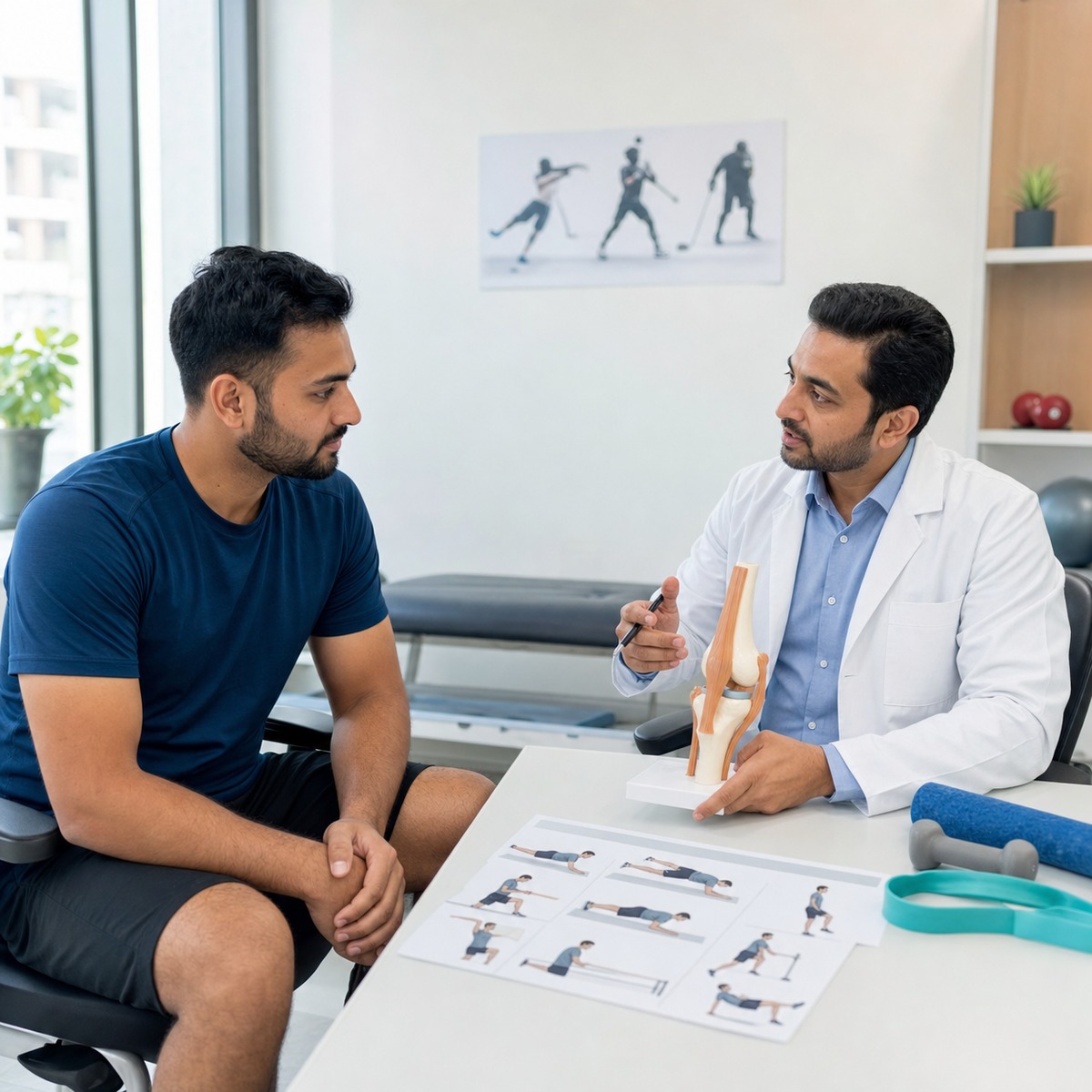
Quick answer: Sports injury doctor Jaipur care is useful when pain keeps returning, workload rises quickly, swelling appears, strength drops or an athlete cannot trust a knee, shoulder, hip or hamstring. Rest alone may calm symptoms but miss the cause. A diagnosis-led plan uses examination, selective scans, rehab and staged return to play.
What matters for this general decision
- Repeated sports niggles should be treated as workload and recovery signals, not ignored until a major tear occurs.
- Overuse injuries usually build gradually when tissues do not get enough time to recover.
- Sudden swelling, instability, locking, weakness or inability to continue activity needs earlier review.
- X-ray, ultrasound and MRI answer different questions; the examination should guide the scan.
- Return to play needs pain control, strength, movement quality and sport-specific testing.
Sports injury doctor Jaipur searches often start after a cricketer, runner, badminton player, gym user or weekend athlete gets the same pain again and again. Current Indian cricket coverage has focused on repeated niggles and workload concerns, but this article does not diagnose any player. It explains how active patients can respond safely in 2026.
When do repeated niggles need a sports injury doctor?
Repeated niggles need a sports injury doctor when pain keeps returning with the same activity, limits performance, changes technique, causes swelling, or needs painkillers to continue. Early review is also sensible when symptoms shift from mild soreness to weakness, giving way, night pain or loss of confidence.
A niggle is not a formal diagnosis. It may be a muscle strain, tendon overload, cartilage irritation, ligament sprain, stress reaction or referred pain from another joint. A repeated niggle is a workload signal until examination proves otherwise. For knee symptoms, review knee treatment in Jaipur; for shoulder symptoms, see shoulder pain treatment.
Recurring pain is information. It should change training before it becomes a forced break.
How does workload cause overuse injury?
Workload causes overuse injury when training volume, match load, bowling spells, gym intensity or recovery changes faster than tissue capacity. Muscles, tendons, cartilage and bone adapt to load, but rapid spikes or repeated stress without recovery can create pain, swelling, weakness and tissue damage.
The American Academy of Orthopaedic Surgeons explains that overuse injuries occur gradually when repeated activity does not allow soft tissues enough time to recover. A 2026 PubMed-indexed systematic review on cricket fast bowlers found that high acute workloads, rapid workload escalation and inadequate recovery were consistently linked with higher injury risk, although methods varied and causation should be interpreted cautiously.
| Pattern | Possible tissue signal | Safer response |
|---|---|---|
| Pain only after extra training | Early overload or fatigue | Reduce spike, check technique and recovery |
| Pain during warm-up that eases | Tendon or muscle irritability | Modify load and assess if repeated |
| Swelling after sport | Joint irritation or internal injury | Stop play and get examined |
| Weakness, limp or altered throw | Loss of control or protective pattern | Review strength and movement quality |
| Pain despite rest | Missed diagnosis or poor capacity | Clinical review and targeted testing |
Which symptoms need urgent review after sport?
Urgent review is needed after sport when pain is severe, swelling is rapid, the joint looks deformed, walking is unsafe, the knee locks, the shoulder cannot lift, the limb feels numb, or fever and redness appear. A pop with instability or inability to continue activity should not be dismissed.
Mayo Clinic sports medicine guidance on ACL injuries lists a pop, severe pain, inability to continue activity, rapid swelling, reduced motion and giving way as typical warning symptoms. Similar principles apply across sports injuries: the red flag is loss of safe function, not the scoreboard or tournament schedule.
- Rapid swelling inside a knee after a twist or landing
- Shoulder dislocation feeling, dead arm or repeated slipping
- Hamstring or calf pain with sudden weakness or bruising
- Persistent limp, catching, locking or giving way
- Severe pain after a fall, collision or road incident
- Numbness, cold foot or hand, fever, redness or open injury
Do I need X-ray, ultrasound or MRI?
You need the test that answers the clinical question. X-ray checks fracture, alignment and arthritis. Ultrasound can help with selected superficial muscle, tendon and fluid problems. MRI is useful when ligament, meniscus, cartilage, bone stress or combined soft-tissue injury is suspected and the result will change treatment.
For sports injury doctor Jaipur patients, a scan should support the examination. Imaging can miss timing, workload, technique, strength, footwear, surface and recovery issues. It can also show old changes that are not causing the current pain.
- History: identify the exact load spike, impact, twist, pop, swelling and ability to continue.
- Examination: compare motion, strength, tenderness, stability, nerve signs and function.
- Basic imaging: choose X-ray when bone injury, deformity or arthritis may explain symptoms.
- Soft-tissue imaging: choose ultrasound or MRI only when it can change the plan.
- Rehab testing: reassess strength and movement before return to play.
Can I keep playing with pain?
No, not when pain is changing movement, increasing during play, causing swelling, needing repeated tablets, or reducing confidence. Mild muscle soreness after new exercise may be monitored, but joint swelling, sharp pain, weakness, locking or instability should stop sport until assessed.
Playing through pain can convert a manageable load problem into a longer injury break. The safer approach is relative rest: reduce the painful load while maintaining safe conditioning, mobility and strength. For ligament or meniscus symptoms, read the approved pages for ACL treatment and meniscus tear care.
Painkillers should not be used as permission to complete a match.
How is return to play planned safely?
Return to play is planned by matching the diagnosis, tissue healing, strength, control, confidence and sport demands. The athlete should first walk normally, then train without swelling, then complete graded drills. Match play comes only after sport-specific movements are tolerated without next-day worsening.
clinical decision: In my 21 years of practice in Jaipur, Clinicians commonly assess athletes arrive after two cycles of rest and relapse. The missing step is usually not another tablet. It is a measurable bridge from symptom relief to workload tolerance: strength, landing control, throwing volume, bowling load, stairs, turns and next-day response.
- Control pain and swelling without masking symptoms.
- Restore full useful motion and daily walking.
- Build strength in the injured area and connected joints.
- Add balance, landing, cutting, throwing or bowling drills gradually.
- Return to practice before competitive play.
- Track next-day pain, swelling and confidence after each load increase.
When to See a Doctor
See an orthopedic sports injury doctor when pain returns repeatedly, performance drops, swelling appears, or the same area fails each time training increases. Seek urgent care for deformity, inability to bear weight, sudden weakness, severe swelling, locking, numbness, fever or pain after high-energy trauma.
- You have repeated knee, shoulder, hip, hamstring or ankle pain during sport.
- A previous injury returns whenever training increases.
- You are unsure whether a scan is needed before a tournament.
- You need a second opinion before surgery, injection or long rest.
- You want a staged return plan after ACL, meniscus, rotator cuff or tendon injury.
Frequently Asked Questions
What is the best sports injury doctor Jaipur patients should see?
The best sports injury doctor Jaipur patients should see is an orthopedic specialist who examines the injured joint, understands sport demands, and plans rehab before return. Look for knee, shoulder, arthroscopy and sports-injury experience. The right doctor should explain diagnosis, scan need, non-surgical care, surgery options and safe progression clearly.
When should I stop playing with a sports injury?
Stop playing if pain becomes sharp, movement changes, swelling appears, strength drops, the joint gives way, or you need painkillers to continue. Stop immediately after a pop, dislocation feeling, locking, numbness or inability to bear weight. Continuing through these signs can worsen injury and delay return.
Do repeated niggles always mean a tear?
No. Repeated niggles can come from tendon overload, muscle fatigue, joint irritation, training spikes, poor recovery, footwear, technique or strength imbalance. A tear is only one possibility. The pattern, examination and response to load guide diagnosis. Persistent or recurring symptoms deserve review before sport-specific demands are increased.
Is MRI required for every sports injury?
No. MRI is useful when examination suggests ligament, meniscus, cartilage, bone stress or complex soft-tissue injury and the result will change management. Some injuries need X-ray first, some can be treated clinically, and some superficial tendon or muscle problems may use ultrasound. The scan should answer a defined question.
How long does return to play take?
Return to play can take days, weeks or months depending on the diagnosis, tissue injured, swelling, strength, surgery need and sport demands. A calendar date alone is unsafe. Athletes should progress from daily function to training drills to practice and competition only when symptoms and next-day response stay controlled.
Can sports injury rehab prevent recurrence?
Rehab can reduce recurrence risk when it corrects strength, mobility, balance, landing, throwing, bowling or running deficits and improves workload progression. It cannot remove all injury risk. The best plan combines diagnosis, progressive loading, rest, technique work, equipment checks and honest tracking of pain or swelling after activity.
How to use this information: Plan Sports Injury Doctor Jaipur Care Early
Sports injury doctor Jaipur care should begin before a repeated niggle becomes a season-ending problem. Pain that returns with workload, causes swelling, changes technique or reduces confidence deserves diagnosis-led review. Conservative care, physiotherapy, imaging or arthroscopy should be chosen only after the injured tissue and sport demands are understood.
Medical disclaimer: This article is for educational purposes only and is not a substitute for professional medical advice, diagnosis, or treatment. Please consult a qualified orthopedic surgeon for guidance specific to your condition.
Author : Dr. Naveen SharmaDr. Naveen Sharma — Medical Director & Senior Joint Surgeon
Dr. Naveen Sharma (MS Ortho, MBBS) is recognized as one of India's foremost authorities on Direct Anterior Approach (DAA) Hip Replacement and Subvastus Muscle-Sparing Knee Arthroplasty.
Dr. Naveen Sharma
Recognized as Rajasthan’s foremost authority on Direct Anterior Approach (DAA) Hip Replacement and Subvastus Fast-Track Knee Arthroplasty with over 21 years of surgical tenure and 20,000+ completed procedures.
