
DAA Hip Replacement for AVN: Who May Be Suitable?
Is DAA hip replacement suitable for every AVN patient?
DAA hip replacement for AVN is not selected from the diagnosis name alone. The surgeon first determines whether the femoral head can still be preserved or whether total hip replacement is now the more appropriate discussion. A systematic review of randomized trials on pre-collapse osteonecrosis found no single universal joint-preserving treatment, which supports establishing the stage before choosing a surgical pathway.
If replacement is being considered, DAA is one possible route to the joint. The choice then depends on bone shape, previous surgery, skin and soft tissue, medical risks, reconstruction complexity, equipment, and the operating team's experience. For AVN, the decision to replace the hip and the decision to use DAA are two separate clinical questions.
Review the AVN hip treatment options before comparing replacement approaches.
What does DAA change after hip replacement is chosen?
Total hip replacement can be performed through anterior, lateral, or posterior pathways. The implant goal remains to replace damaged joint surfaces and create a stable reconstruction. The approach changes the working corridor, patient positioning, instruments, soft-tissue exposure, and parts of early rehabilitation.
A 2017 systematic review of the direct anterior approach reported possible early recovery advantages in some measures, but the studies differed in design and results. No approach is automatically best for every patient.
The DAA versus traditional hip replacement comparison explains the general trade-offs. This guide focuses on how those trade-offs apply when AVN is the reason for replacement.
Which factors shape DAA candidacy in AVN?
AVN stage and reconstruction needs: Current X-rays and MRI help clarify collapse, arthritis, lesion extent, bone quality, and whether joint preservation is still realistic. A straightforward primary replacement differs from surgery involving major deformity, retained metalwork, fracture damage, infection concerns, or revision components.
Previous procedures: Prior core decompression, bone grafting, fracture fixation, scars, or retained implants can change the surgical corridor. The surgeon must decide whether DAA still gives safe exposure or whether another route provides better access.
Body shape and soft tissue: Tissue depth, skin folds, muscle bulk, and skin condition can affect exposure and wound monitoring. Body weight alone should not be treated as a simple pass-or-fail rule.
A 2026 systematic review of DAA in patients with obesity found comparable functional improvement but higher complication and reoperation rates than in non-obese groups, supporting individual risk assessment rather than blanket exclusion.
Medical readiness: Diabetes control, smoking, anaemia, heart or lung disease, blood-thinning medicines, infection risk, and walking ability before surgery affect the complete operation and rehabilitation plan.
Surgeon and hospital factors: Familiarity with the approach, appropriate instruments, anaesthesia planning, blood management, physiotherapy, and follow-up systems all matter. A familiar approach chosen for the correct reconstruction may be safer than selecting DAA mainly because it sounds less invasive.
What should you bring to the approach discussion?
Bring recent pelvis and hip X-rays, the MRI used to stage AVN, records of earlier operations or injections, and a complete medicine list. Describe groin pain, stiffness, limping, sleep disturbance, walking limits, and how symptoms affect work or daily independence.
Ask whether the femoral head has collapsed, why replacement is being discussed now, whether any preservation option remains reasonable, and which approaches can safely complete the planned reconstruction. The discussion should also cover implant planning, leg-length goals, wound care, blood-clot prevention, walking-aid use, and what might make the approach change during surgery.
The broader hip replacement assessment pathway can help you organize symptoms, earlier treatment, and imaging before this discussion.
Questions to ask before agreeing to DAA
A useful consultation should explain the diagnosis, reconstruction, and alternatives rather than focus only on the name of the incision. Ask the surgeon to show the AVN changes on your X-ray or MRI and explain whether the femoral head has retained its shape. If replacement is advised, ask what makes preservation unlikely to meet your goals.
- Which findings make total hip replacement appropriate now?
- Is DAA one reasonable option for my anatomy, or is another approach safer?
- Could previous core decompression, fixation, scarring, or bone loss change the exposure?
- What medical conditions need attention before elective surgery?
- What walking aid, home support, wound care, and follow-up will I need?
- What circumstances could require the surgeon to change the planned approach?
An approach decision is incomplete when it rests mainly on a marketing label or when AVN stage, alternatives, and limitations remain unexplained. A complete decision record states the imaging findings, why replacement is being considered, which approaches are feasible, and what factors could change the plan. The goal is a stable reconstruction and a clear recovery pathway, not obtaining a particular incision at any cost.
Does DAA guarantee faster walking after AVN surgery?
No approach guarantees a fixed walking or recovery date. Early mobility depends on preoperative strength, AVN-related bone damage, reconstruction complexity, pain control, balance, medical health, physiotherapy, home support, and complications. A smaller-looking incision does not reveal how difficult the reconstruction was.
Recovery planning should define safe transfers, walking-aid use, wound observation, activity progression, and follow-up. The hip replacement recovery guide gives a broader framework that applies regardless of approach.
What the accompanying Facebook image does and does not show
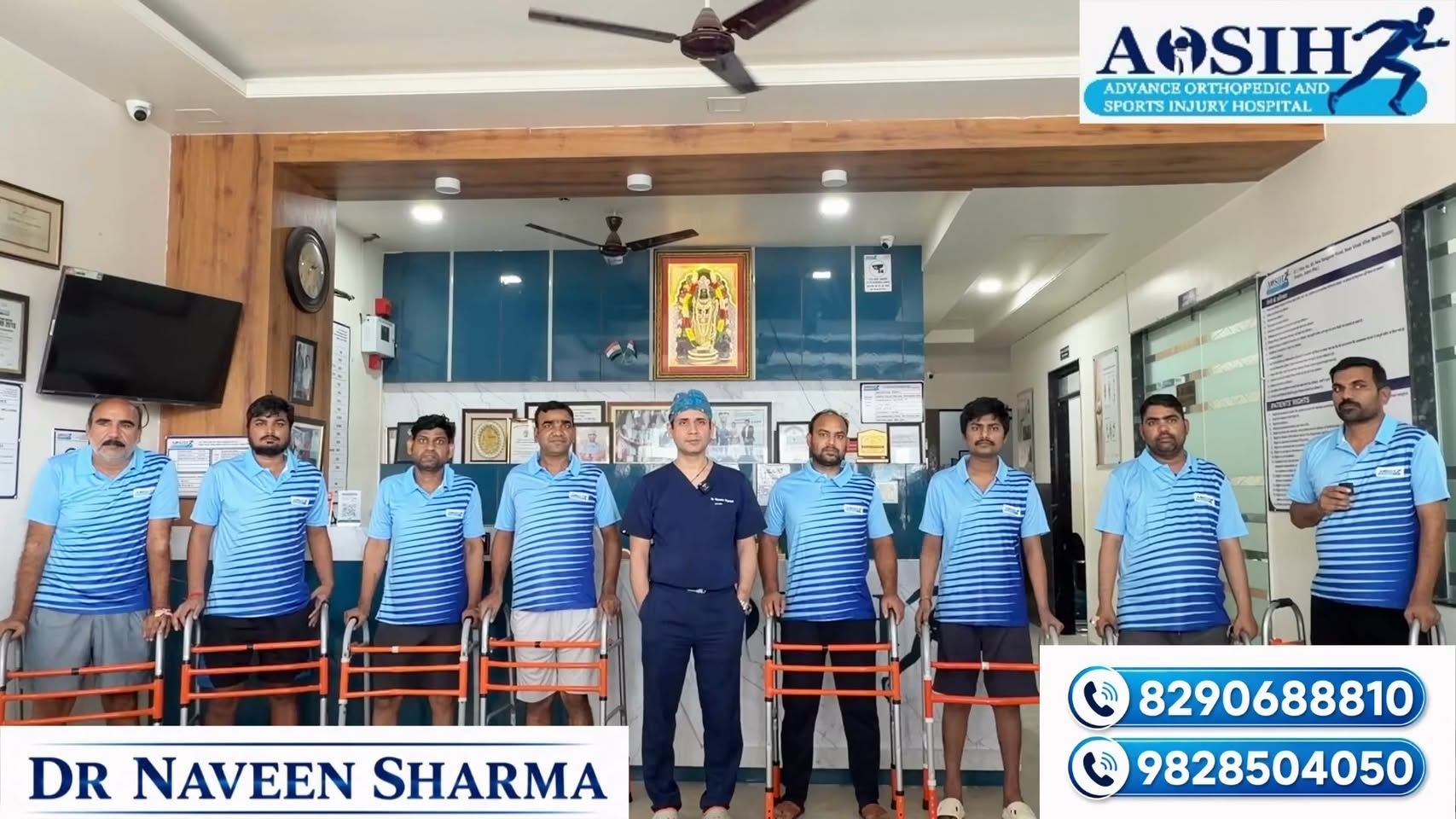
The proposed cover is a clinic photograph taken from Dr. Naveen Sharma's public Facebook post. It is used only as practice context. The image does not establish any person's diagnosis, procedure, recovery speed, or outcome, and it should not be interpreted as evidence that DAA is suitable for every AVN patient.
When does the plan need urgent review?
New inability to bear weight, severe worsening hip pain, fever, a skin infection near the planned incision, or a significant change in general health needs prompt clinical review. After surgery, increasing wound drainage, spreading redness, marked calf swelling, chest discomfort, breathing difficulty, sudden weakness, or a new inability to walk requires urgent assessment.
Do not use an online checklist to overrule the treating team. If updated imaging or examination changes the proposed approach, ask why the alternative route is safer for the actual reconstruction.
What this guide cannot decide
This guide cannot stage AVN, determine whether the natural joint can be preserved, or select a surgical approach without examination and imaging. Published comparisons combine different surgeons, hospitals, rehabilitation pathways, and patient groups, so average findings do not predict one person's result.
DAA should not be treated as a product tier or proof of surgical quality. Diagnosis, implant planning, stable reconstruction, soft-tissue handling, complication prevention, and follow-up matter more than a marketing label.
Sources and evidence
- Treatment of Pre-Collapse Stages of Osteonecrosis of the Femoral Head: a Systematic Review of Randomized Control Trials.
- The direct anterior approach in total hip arthroplasty: a systematic review of the literature.
- Feasibility and outcomes of the direct anterior approach in total hip arthroplasty for obese patients: a systematic review.
Need an AVN and approach-specific opinion?
For a diagnosis-led review of AVN imaging and hip replacement options in Jaipur, use the orthopedic consultation page. Bring current imaging and previous treatment records so the discussion can compare appropriate approaches rather than promise one technique in advance.
Medical disclaimer
This article is educational and cannot diagnose AVN, determine its stage, or select a surgical approach. Individual decisions require examination, imaging, and medical assessment.
Author : Dr. Naveen SharmaDr. Naveen Sharma — Medical Director & Senior Joint Surgeon
Dr. Naveen Sharma (MS Ortho, MBBS) is recognized as one of India's foremost authorities on Direct Anterior Approach (DAA) Hip Replacement and Subvastus Muscle-Sparing Knee Arthroplasty.

Dr. Naveen Sharma
Recognized as Rajasthan’s foremost authority on Direct Anterior Approach (DAA) Hip Replacement and Subvastus Fast-Track Knee Arthroplasty with over 21 years of surgical tenure and 20,000+ completed procedures.
